E-Jus Publicum Project Officially Launched
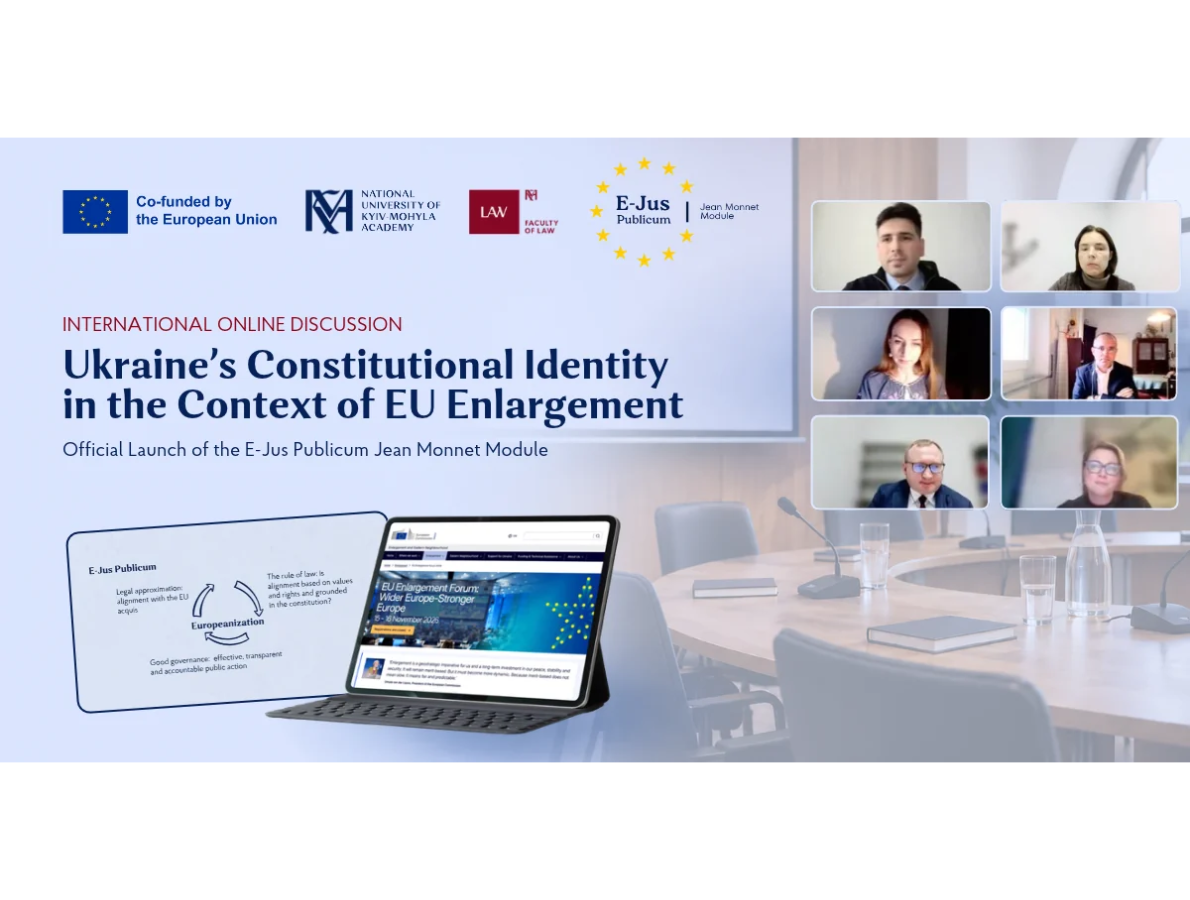
On 13 November 2026, the Faculty of Law at the National University of Kyiv-Mohyla Academy hosted an international online discussion entitled “Ukraine’s Constitutional Identity in the Context of EU Enlargement.” The event marked the official launch of E-Jus Publicum, a Jean Monnet Module implemented under the Erasmus+ Programme and co-funded by the European Union.
The discussion addressed a question of particular importance in the context of European integration and the full-scale war: how can Ukraine reconcile its constitutional traditions with the EU’s common legal acquis while preserving its constitutional identity?
The discussion was held as a satellite event of the EU Enlargement Forum 2026: Wider Europe – Stronger Europe, which opens in Brussels on 16 November. The Forum brings together representatives of European institutions, governments, expert communities, and academia to discuss the future of EU enlargement, the strengthening of democracy, the rule of law, and European security.
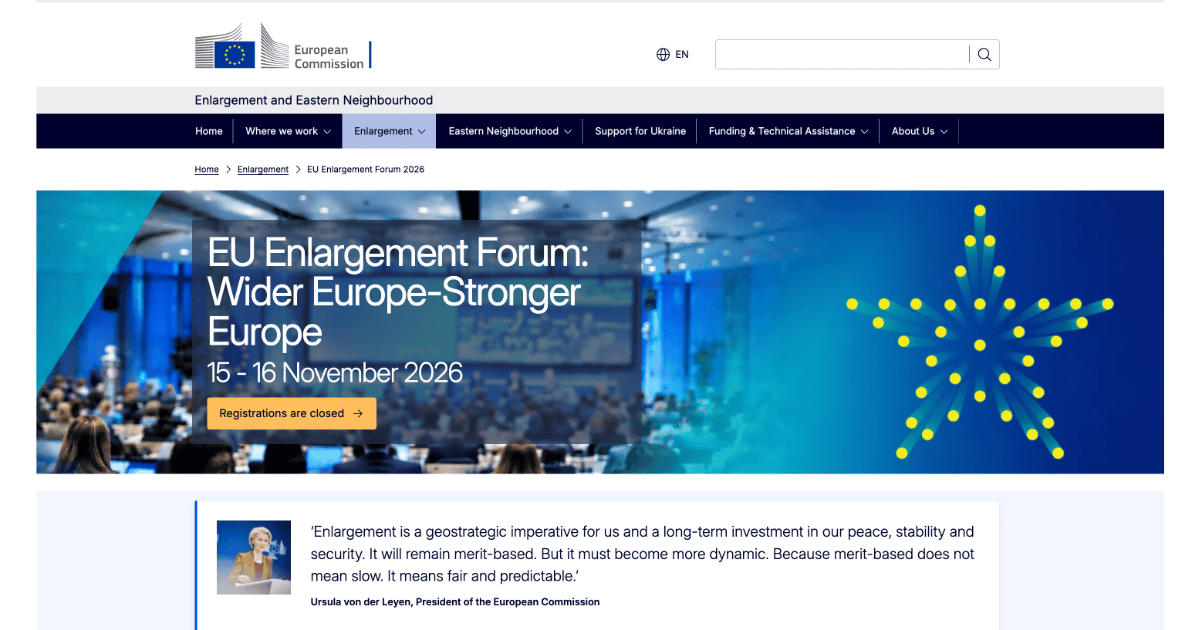
We invite everyone to participate in the Forum’s events and follow the discussions on the future of European integration.
More information about the Forum’s programme and related events is available on the official website of the European Commission.
E-Jus Publicum: A New Stage in the Development of European Legal Studies at Kyiv-Mohyla Academy
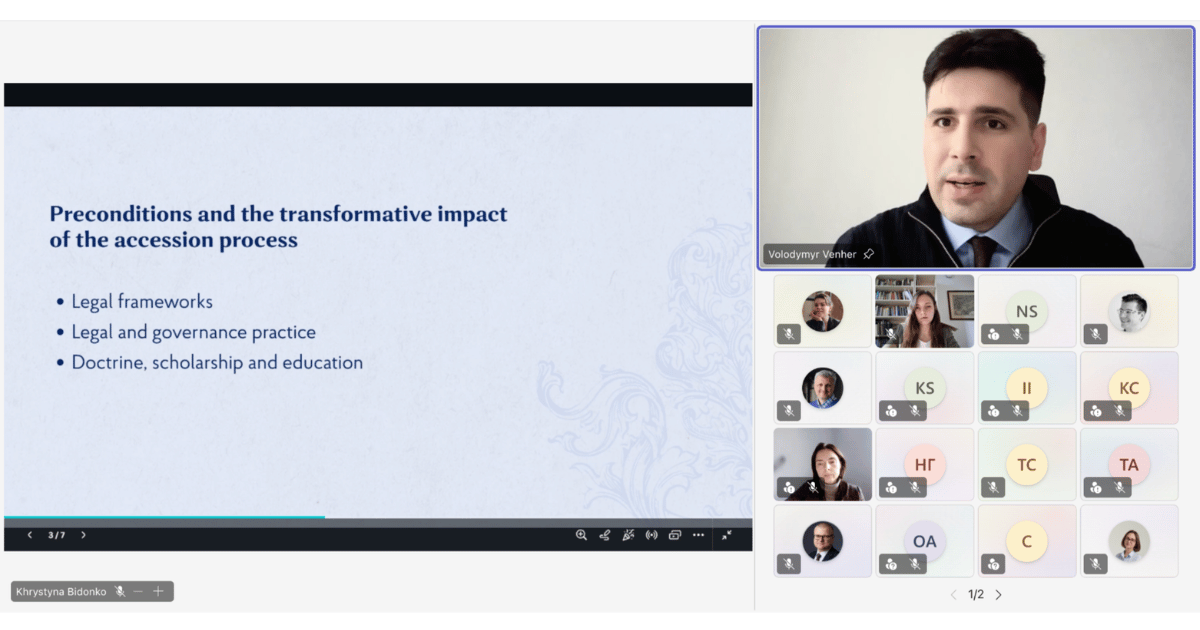
One of the central parts of the event was the presentation of the Jean Monnet Module E-Jus Publicum — “Europeanization of Public Law and Public Administration for the Rule of Law and Good Governance in the Accession Context.”
The project will run for 36 months. Its academic coordinator is Dr Volodymyr Venher, Dean of the Faculty of Law at Kyiv-Mohyla Academy.
Introducing the background to the project, Volodymyr Venher emphasised that Ukraine’s European integration is not limited to legislative approximation or compliance with economic requirements. It involves much deeper changes in legal thinking, the understanding of fundamental legal values, the application of law, and legal education.
In particular, he drew attention to the influence of the Soviet legal tradition, which remains evident in Ukrainian legal education and practice. Overcoming this legacy requires not only legislative reform but also a reconsideration of approaches to teaching law, interpreting legal provisions, and applying the principles of the rule of law, democracy, and human rights.
The Dean also emphasised the need to integrate European legal approaches across different academic disciplines rather than limiting their study to individual courses on EU law.
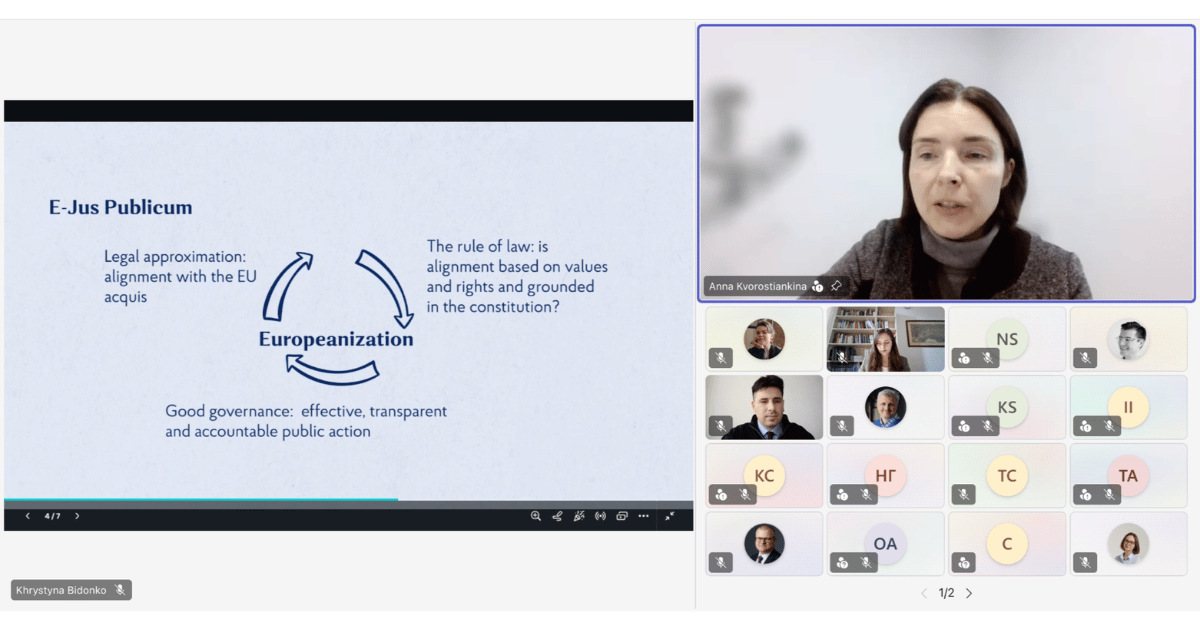
The presentation continued with Dr Anna Khvorostiankina, a lecturer within the Jean Monnet Module, who provided further details about its objectives, content, and planned activities.
She explained that E-Jus Publicum builds on Kyiv-Mohyla Academy’s previous achievements in EU law, particularly its experience in implementing Jean Monnet projects, while also expanding the scope of research. The project will examine the impact of European integration on national constitutional and public law, the functioning of state institutions, and legal culture.
An important distinction concerns legislative approximation to EU law and the broader process of legal transformation. The latter encompasses not only amendments to legislation and regulations but also their practical application, legal reasoning, methods of legal interpretation, and approaches to public administration.
What Does the Project Involve?
E-Jus Publicum will focus on three interconnected areas: education, research, and professional dialogue with policy-makers and civil society.
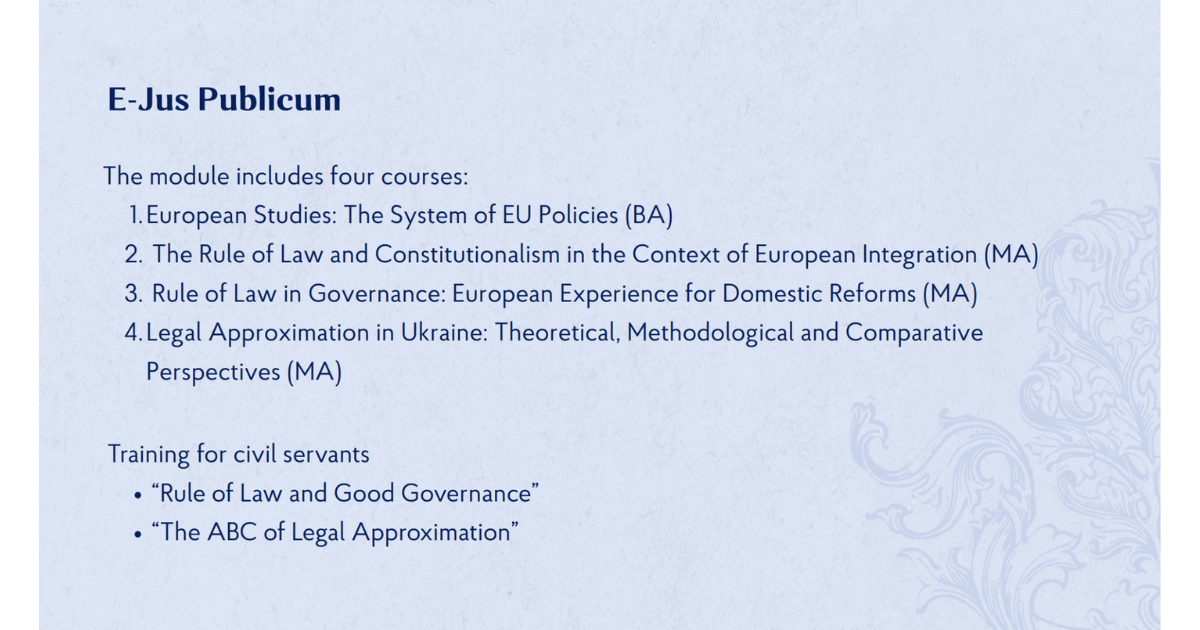
The educational component includes the development and updating of four academic courses:
- “European Studies: The System of European Union Policies”;
- “The Rule of Law and Constitutionalism in the Context of European Integration”;
- “The Rule of Law in Public Administration: European Experience for National Reforms”;
- “Legal Approximation in Ukraine: Theoretical, Methodological and Comparative Aspects”.
The project also provides for professional training for civil servants and legal practitioners in two areas: “The Rule of Law and Good Governance” and “Fundamentals of Legal Approximation”.
The research component will focus on comparative analyses of the Europeanisation of public law, mechanisms for safeguarding the rule of law, and constitutional changes in the EU accession process.
The expected outcomes include the participation of 300 students in academic courses, two professional training sessions for 60 participants, the publication of two peer-reviewed academic articles, and the organisation of an international academic forum.
Ukraine’s Constitutional Identity and European Integration: Key Insights from the International Discussion
Following the project presentation, participants proceeded to an international panel discussion examining the relationship between national constitutional identity, state sovereignty, and the legal order of the European Union. The discussion was moderated by Khrystyna Bidonko, lecturer and team member of the E-Jus Publicum.
Lithuania’s Experience: European Integration as a Dialogue Between Constitutional Traditions
Dr Indrė Isokaitė, Head of the Department of Public Law and the Centre of Ukrainian Law at the Faculty of Law of Vilnius University, presented Lithuania’s experience of European integration and its potential relevance to Ukraine.
She highlighted that constitutional identity is shaped by a country’s history, its struggle for freedom, societal values, and national traditions. At the same time, EU membership does not necessarily require states to abandon these distinctive characteristics.
In her view, the relationship between national constitutional traditions and the EU legal order should be understood not as a confrontation but as an ongoing dialogue based on mutual trust, cooperation, and shared values.
Indrė Isokaitė also emphasised that Ukraine’s experience cannot be directly compared with that of the countries that joined the EU in 2004. Ukraine is pursuing European integration under fundamentally different circumstances, particularly during wartime, while already having its own achievements in technology, security, and the development of state institutions.

Ukraine’s Sovereignty in the Context of European Integration
Prof. Dr Kseniia Smyrnova, President of the Ukrainian Association of European Law, focused her presentation on the relationship between state sovereignty and the principle of the primacy of EU law.
She stressed that sovereignty is not an abstract legal concept for Ukraine, as the country must defend it amid the full-scale war. At the same time, future membership in the European Union offers opportunities for a new understanding of sovereignty through participation in common institutions and the development of European rules.
“Accession to the EU is not a renunciation of sovereignty, but its highest institutional expression,” Kseniia Smyrnova emphasised.
She also identified three levels of Europeanisation: legislative, governmental, and judicial. She highlighted the need not only to adopt legislation aligned with European standards but also to ensure its effective implementation by public authorities and courts.
Another important aspect of her presentation was the role of legal education and academic expertise in preparing professionals capable of working with EU law and participating in Ukraine’s EU accession negotiations.

The Italian Experience: Does Ukraine Need Constitutional Amendments to Join the EU?
Dr Enrico Albanesi, Associate Professor of Constitutional Law at the University of Genoa, Italy, examined Ukraine’s European integration through the lens of Italian constitutional experience.
He explained that Italy provides an example of a country that was able to establish a constitutional basis for participation in European integration by relying on existing provisions of its Constitution.
Drawing on this experience, he proposed a hypothesis for discussion: could the provisions of the Constitution of Ukraine concerning the irreversibility of its European course and its aspiration to full EU membership serve as a sufficient constitutional basis for accession without introducing a separate new provision?
This question has particular practical significance because Article 157 of the Constitution of Ukraine prohibits constitutional amendments during martial law or a state of emergency.
Enrico Albanesi stressed that this approach remains open to debate and requires appropriate constitutional interpretation, particularly by the Constitutional Court of Ukraine.

Constitutional Identity and the Role of Judicial Dialogue
Dr Nazarii Stetsyk, a Marie Skłodowska-Curie Fellow at the University of Vienna, addressed methodological questions concerning the definition of constitutional identity and the relationship between national and European legal orders.
In his presentation, he proposed distinguishing between the identity of a people, encompassing historical, cultural, and social characteristics, and the identity of a constitution as a legal document.
He also emphasised the importance of combining a values-based approach to law with careful attention to the constitutional text. In his view, European integration requires not only a reconsideration of legal principles but also a thorough analysis of constitutional provisions and potential conflicts between national legal norms and obligations arising from EU membership.
Among the examples discussed were the relationship between constitutional guarantees and mechanisms of legal cooperation among EU Member States.

European Integration as a Process of Mutual Transformation
One of the recurring themes of the international discussion was the understanding of European integration as a process that transforms not only the candidate country but also the European Union itself.
Participants examined the experiences of EU Member States, the significance of national constitutional traditions, mechanisms for safeguarding the rule of law, and the role of courts in shaping a common European legal space.
Particular attention was paid to the potential contribution of Ukraine’s constitutional tradition, its experience in defending statehood, and its commitment to democratic values to the further development of European constitutionalism.
The launch of E-Jus Publicum creates additional opportunities to continue this dialogue through education, research, international academic cooperation, and the exchange of practical experience.
The project aims to contribute to the education of a new generation of legal professionals, the development of expertise in EU law, and the strengthening of Ukrainian state institutions’ capacity to implement European legal standards.
The E-Jus Publicum project is implemented as a Jean Monnet Module under the Erasmus+ programme and is funded by the European Union. Views and opinions expressed are, however, those of the author(s) only and do not necessarily reflect those of the European Union or the European Education and Culture Executive Agency (EACEA). Neither the European Union nor EACEA can be held responsible for them.