National minorities and Ukraine’s EU integration: Viktoriia Khalanchuk presents research at ECPR conference

The issue of national minorities has become a prominent part of Ukraine’s EU accession negotiations. Viktoriia Khalanchuk, Senior Lecturer at the Department of International and European Law at Kyiv-Mohyla Academy Faculty of Law, is examining the reasons behind this and the role of legal mechanisms in political processes.
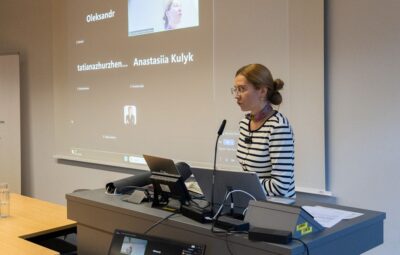
From 8 to 11 September, Viktoriia presented her research project, “Between Warfare and Lawfare: the Issue of National Minorities in Ukraine’s EU Accession Process”, during the panel “Sectoral Dimensions of Ukraine’s European Integration”. The panel was part of the annual General Conference of the European Consortium for Political Research (ECPR), hosted by Uniwersytet Jagielloński w Krakowie.
The ECPR is one of the leading professional organisations in political science, bringing together researchers from Europe and other regions of the world, as well as scholars from related disciplines. National University of Kyiv-Mohyla Academy is an ECPR member institution.
The research draws on Viktoriia’s eight years of professional experience working on national minority issues in the context of interstate relations. It applies lawfare as an analytical framework, understood as the use of law and legal mechanisms to achieve political objectives.
This approach offers an alternative explanation for why the issue of national minorities has assumed a prominent role in Ukraine’s EU accession negotiations.
Read the research abstract on the ECPR website
The protection of national minority rights forms part of the broader rule of law framework, and the relevant requirements for Ukraine should be grounded in international and European Union law. At the same time, the research examines situations in which demands concerning national minority policy have gone beyond direct international legal obligations and European standards, instead reflecting the context-specific national position of a particular state.
The study focuses in particular on Hungary’s position and its consistent advancement of a series of demands concerning Ukraine’s national minority policy. This analysis raises broader questions about whether frequent legislative amendments are consistent with a long-term vision of public policy, how Ukraine can reconcile the fulfilment of its international obligations with the internal integration of society, and how societal resilience can be strengthened.
“Conferences like this are not only an opportunity to test our research ideas. They also allow us to share Ukraine’s experience, explore how similar issues are addressed in other countries, and identify potential partners for future collaborative research,” Viktoriia Khalanchuk said.
Participation in the ECPR conference enabled Viktoriia to present her research to the international academic community and receive expert feedback that will support its further development and preparation for publication.