

NaUKMA Faculty of Law launches EU-funded Erasmus+ Jean Monnet project E-Jus Publicum
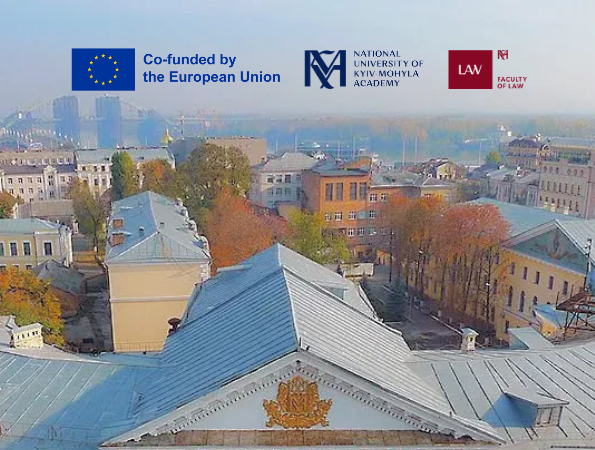
On November 1, 2026, the Faculty of Law at the National University of Kyiv-Mohyla Academy (NaUKMA) will launch E-Jus Publicum, a three-year project funded by the European Union under the Erasmus+ Programme (Jean Monnet Module).
E-Jus Publicum — “Europeanization of Public Law and Public Administration for the Rule of Law and Good Governance in the Accession Context” — aims to advance education and research in European Union law and support Ukraine’s preparations for EU membership.
Ukraine’s European integration requires not only the alignment of national legislation with EU law but also the consistent implementation of the principles of the rule of law, constitutionalism, and good governance. These interconnected areas form the foundation of the project.
The educational component of E-Jus Publicum includes updating three existing courses and introducing one new advanced course for bachelor’s and master’s students. The courses will address EU policies, legal approximation, democratic institutions, and public administration in the context of European integration.
In addition to the courses, the project will include:
– applied research and international academic publications;
– professional training for civil servants;
– international academic events, including a forum bringing together representatives from Eastern Partnership countries;
– open-access educational materials and dissemination of research findings.
E-Jus Publicum activities will be open to students from different disciplines and universities, academic staff, researchers, legal practitioners, and representatives of public authorities.
We will share more information about the project team, courses, upcoming events, and participation opportunities in future posts. Follow the Faculty of Law at NaUKMA on social media and visit our website for updates.
Funded by the European Union. Views and opinions expressed are, however, those of the author(s) only and do not necessarily reflect those of the European Union or the European Education and Culture Executive Agency (EACEA). Neither the European Union nor EACEA can be held responsible for them.


